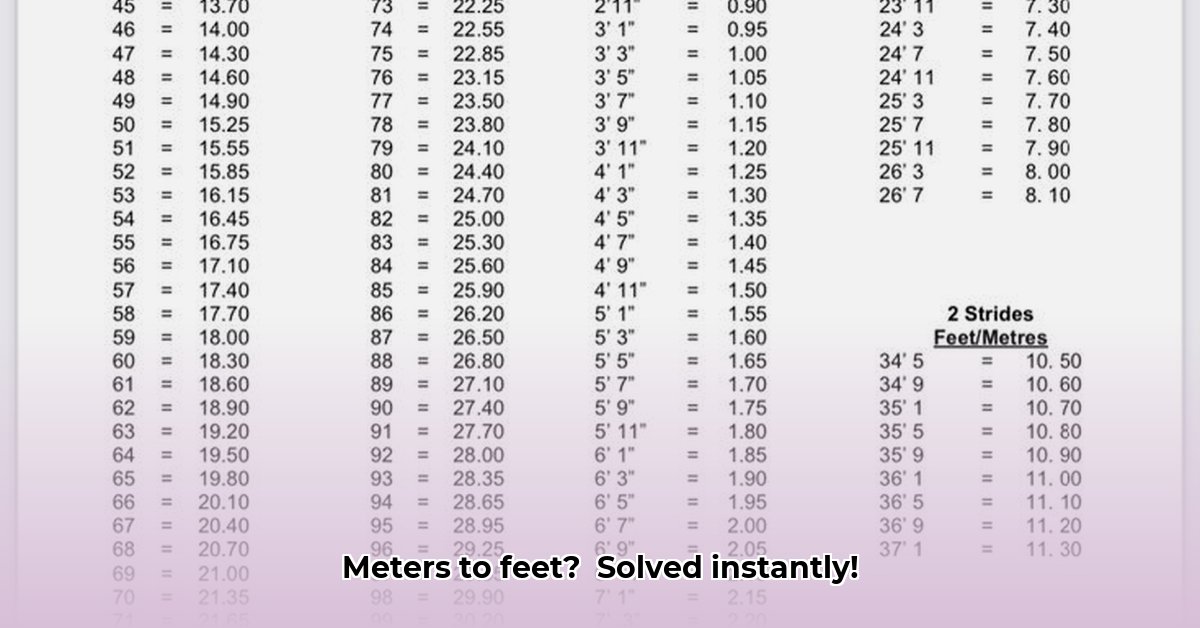
Here's a quick-reference chart for converting meters to feet:
| Meters | Feet (approximately) |
|---|---|
| 1 | 3.28 |
| 2 | 6.56 |
| 3 | 9.84 |
| 4 | 13.12 |
| 5 | 16.40 |
| 10 | 32.81 |
| 20 | 65.62 |
| 50 | 164.04 |
| 100 | 328.08 |
For more detailed conversions, check out this helpful resource: 300 meters in feet.
Understanding Meters and Feet: A History of Measurement
The meter, established during the French Revolution, aimed for a universal length standard, based on a fraction of Earth's circumference. The foot, however, boasts a much older and more varied history, with different versions used across cultures and countries. Interestingly, the modern definition of the foot is linked to the meter, highlighting the intertwined nature of these systems. This blend of historical development and modern standardization makes the continued use of both systems a compelling story of measurement evolution.
Converting Meters to Feet (and Vice Versa): Simple Steps
The simplest conversion uses the approximate factor: 1 meter ≈ 3.28 feet. To convert meters to feet, multiply the number of meters by 3.28. For example, 10 meters is approximately 10 * 3.28 = 32.8 feet. To convert feet to meters, divide the number of feet by 3.28. For enhanced accuracy, numerous online converters provide instant, precise results, eliminating potential calculation errors. Isn't it amazing how easily these two seemingly different units are interconvertible?
Real-World Applications: Where Conversions Matter
Converting between meters and feet is essential in various fields. In construction, blueprints may use feet even in metric countries. Accurate conversions prevent costly mistakes in aviation, where altitudes are frequently given in both feet and meters to ensure safety and avoid confusion. International trade relies heavily on precise conversions to prevent errors in shipments and manufacturing. Imagine the issues if a shipment of building materials arrived with a small but significant discrepancy. Such errors might cause delays or even result in needing to redo parts of a project, potentially costing billions in rework and delays.
Going Deeper: Accuracy and Potential Pitfalls
While the conversion is straightforward, remember that historical measurements weren't always precise. Older definitions of the foot varied considerably. Converting very old measurements may include a degree of uncertainty because the initial values weren't perfectly exact. Modern definitions significantly improve accuracy. For scientific applications, understanding significant figures—the number of meaningfully precise digits in a measurement—is critical for minimizing errors. This detailed attention to precision and possible sources of error is essential for high-stakes applications.
How to Accurately Convert Feet to Meters in Aviation
Aviation uses both feet and meters for altitude, creating complexities. The standard conversion is 1 foot = 0.3048 meters, but practical application requires more. Altimeter settings (QNH and QFE) and flight levels (FL) add layers of complexity. Accurate conversion is crucial for safety and communication between pilots and air traffic control.
Key takeaways: Aviation’s dual use of feet and meters for altitude highlights the importance of accurate conversion. Understanding altimeter settings and flight levels is crucial for safe, efficient flight operations. Accurate conversions prevent potentially dangerous miscommunications.